How did Riverbend describe pre-war relations between Iraqis of various religions and ethnicities living in Baghdad?
What is her religion?
What is her opinion of conservative and extremist Sunnis and Shi’ites?
What is her opinion of Christians?
What is her opinion of Kurds?
What evidence does she provide that the seeds of ethnic and religious civil war are being planted in Iraq by 2003?
Based on your reading of Brigham, what was General Casey's plan to calm Iraq when he took over command of occupation forces in July 2004? Why did "events in Iraq…overrun the plan" (p. 165)?
*Sunni
Majority of Islamic believers
*Shi’ite
Minority in Islam
Majority in Iraq and Iran
April 2003-June 2004
L. Paul Bremmer
Appointed June 2004-May 2005
Transitional government elections, Jan. 2005
Served May 2005-May 2006
Iraq constitution approved, Oct. 2005
Shi'ite-Kurd coalition government
*Nouri al-Maliki, Prime Minister
Iraq Parliamentary Elections, Dec. 2005
Sunni Arab boycott
*Askariya "Golden Domed" shrine bombed, Feb. 2006
Samarra
Holy Shi'ite site
12th Imam
Iraqi government formed, May 2006
Shi'ite-Kurd coalition government
Sunni Arab parties not included
Resentment of Sunni Arabs
Government tacitly supports Shi’ite militias
(Source: CSIS Recent Trends in Iraq War, p. 8)
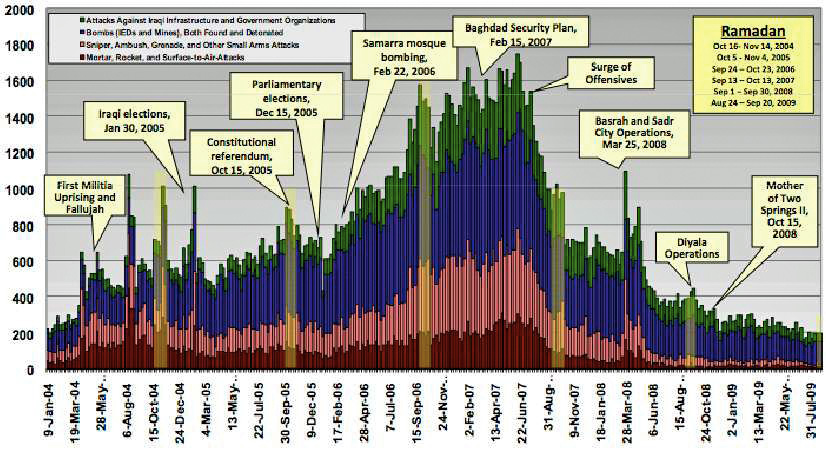
(Source: Measuring Security and Stability in Iraq, p. 25)
*Ba'athists and other secular loyalists
IEDs (Improvised Explosive Devices)
Mortars, assassinations
Islamic Fundamentalists (al-Qaeda)
Suicide bombings
Badr Brigade
Karbala
*Al-Mahdi Army
Baghdad (Sadr City) and Basra
*Moqtada al-Sadr
✓Repression breeds political awareness and resentment
Saddam's repression (Saddam was a secular Sunni)
Kurds in 1980s
Shi'ite Arabs in south in 1991
Shi’ite Parties form government in 2006
Sunni Arab boycott of elections and alienation
✓Regime shifts, political instability, weak states
U.S. occupation of Iraq 2003-present
Various militias formed for self-protection and/or aggression
“Vicious cycles” of radicalization
✓Attacks increase mutual fear and resentment
✓Special circumstances of rural Arab culture
Vendetta preserves family honor
Sparks setting off vicious cycle:
Bombing of the Askariya "Golden Domed" shrine, Feb. 2006
Shi’ite-Kurd Govt, May 2006
100,000-660,000 depending on estimate
Jordan and Syria (estimated)
2.3 million in 2007
8% of population
2 million, Jan. 2009
1.79 million, Jan. 2010
Internal displacement
2.6 million, Jan. 2009
1.55 million, Jan. 2010
(For current figures, see U.N. High Commission for Refugees "Country Operations Profile: Iraq" )
Syria
"Third Arab country" in 2013
General David Petraeus
Ph.D. (1987) International Relations, Princeton University, Woodrow Wilson School of Public and International Affairs
1) New tactics
Civilian casualties minimized
Paying local insurgents
Sunni Awakening militia
Iraqi troops take lead
U.S. troops provide training and support
2) Surge, June 2008?
28,000 extra troops
1) *Ethnic cleansing completed prior to surge in June 2008
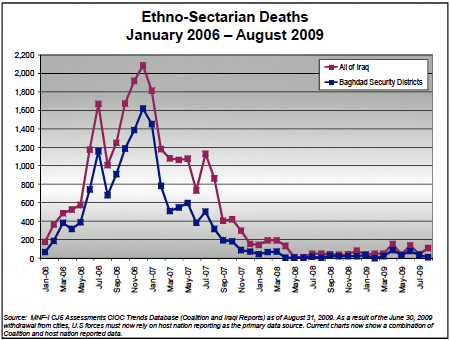
How is this reflected in Chart 1 above?
Baghdad Shi'ite-Sunni ratio (Juan Cole, "Informed Comment," 6/24/10, Professor of Middle Eastern History, University of Michigan)
50-50 in 2003
90-10 in 2008
2) Iraqi Army cracks down on Moqtada al-Sadr's “al-Mahdi Army”
Prime Minister Nouri al-Maliki
Sadr City and Basra, March 2008
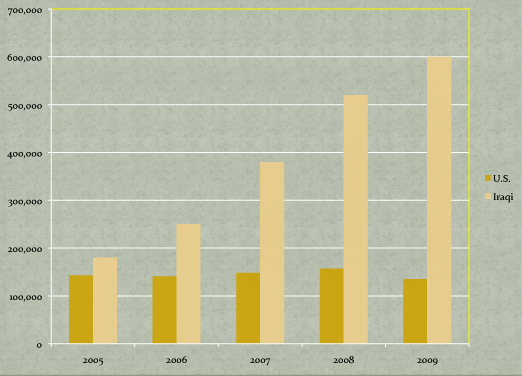
(Sources: Cordesman and Mausner, Withdrawal from Iraq, p. 7 and Belasco, Troop Levels in the Afghan and Iraq Wars, p. 9)
In Chart 3, was the buildup of Iraqi troops or surge of American ones more significant? Would American or Iraqi troops be better suited to enforcing order in Iraq?
Based on Chart 3 and Charts 1 and 2 above, did the increasing numbers of Iraqi troops and their crackdown on the al-Madhi Army (March 2008) or “Surge” of U.S. forces (June 2008) play a greater role in reducing violence?
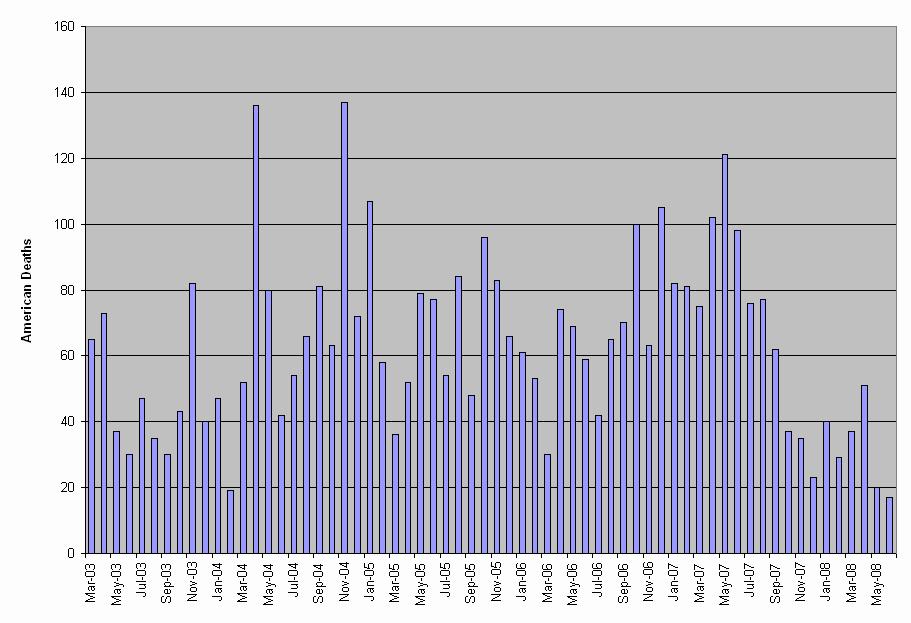
4000+ U.S. Military Deaths (Source: Monthly Statistics)