Text





OKCA Knewsletter, December, 2000
My Dad’s Ka-Bars
By
Michael Yoh
I would like to think that my father and I were alike in most respects, and if that was indeed the case, then it is a most positive compliment to me. Though he has been gone for ten years, I still miss Dad and think of him nearly every day. However alike we were, we certainly differed in one definite characteristic. I am a collector of things; my father wasn’t. In fact, I was once nicknamed the “knick-knack kid” for all the gadgets I hauled around on camping and canoe trips. In contrast, while Dad undoubtedly enjoyed life, people, and outdoor activities, he wasn’t much interested in accumulating things. When he died, I acquired the few tangible things of value that he had: his Marlin 30-30, his Winchester 101, his Remington Model 4- .22, his Elgin pocket watch, his fraternity ring, and his two Ka-Bar sheath knives.
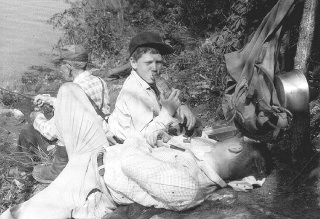
As far back as I can will my memory (at least to 1951), I remember him with one of these two knives, whether it be by a lake leisurely fishing, on a day’s hunting expedition, a canoe trip, or a camping trip. In the picture at the right, Dad is definitely relaxing and I’m sure the smaller Ka-Bar is on his right hip. [That’s me sucking the pop bottle.] He packed simply in his Army Rucksack, using his army mess kit and a few other items acquired from his time in the service, during WWII.
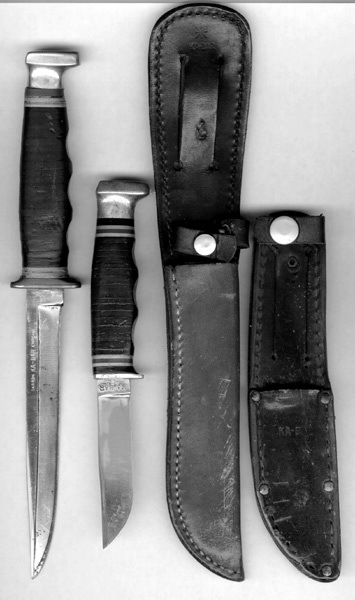
Both of these knives are marked KA-BAR, the smaller one marked KA-BAR USA and the larger one KA-BAR Carbon Chrome. The smaller knife has a 3” blade, stacked leather handle, single guard. The larger knife has a 5 ¼” straight, finely pointed, blade, stacked leather handle, and a small double guard. The butt caps are similar on both knives, being, I believe of aluminum. The smaller knife also had a chrome finish on the blade, though it is not marked carbon chrome. However, this smaller knife has the chrome finish nearly worn off. Each of these knives will take and hold an extremely sharp edge. The leather sheaths are the originals, and are both marked KA-BAR.
I was always intrigued with these two knives. I imagined that my father wore these during World War II, the larger knife appearing to serve as an excellent fighting knife. Dad was in the CIC (Counter Intelligence Corp) and operated much of the time behind German lines. I know that he saw action, but he was never one to talk much about his war experiences, and unfortunately I never thought to ask him to give me the full history of these while he was alive. After WWII, Dad returned to the States and settled into managing a small business. He also became very involved in the Boy Scouts and helped organize a local group of Scouts called the Tuscarora Indians. This group made authentic Native American outfits, slept in tee-pees, and performed in various shows and parades in the area. During this time he was also a founder and member of the “Falling Archers”, a group of bow hunters who camped in the above mentioned tee-pees, and had a heck of a good time deer hunting. I have heard many stories of the escapes of this group. I just wish that the “Falling Archers” had lasted long enough for me to appreciate it. You can see that Dad had plenty of need and opportunity to require a knife for all sorts of tasks. When I was about eight, in 1955, my parents along with a few other families, bought about 1,000 areas of mountain land on which to build cabins, create a lake, and enjoy hunting and nature. These two KA-BAR’s were Dad’s primary knives. Oh, he may have had an inexpensive folding knife from time-to-time, but never for long before losing it. I believe that I once gave him a nice Browning folding trapper, but I believe he stuck this away. For our hunting, canoeing, and camping trips Dad usually seemed to favor the smaller sheath knife, [on his belt in picture at right] and now with some experience behind me, I can see why.
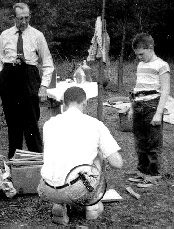
It is the ideal size for most skinning, cleaning, and cutting chores during an average day outdoors. It is unobtrusive and rides on your hip without being in the way.
The 5 ¼” KA-BAR is also a very nice knife. The straight slender blade and double guard suggests that it would have served a military man very well. It is certainly lighter and more compact then the familiar Ka-Bar fighting knife. The blade has a hollow grind and accepts a very nice edge, and holds this edge very well. This knife spent some years as a kitchen knife at our cabin, and though it was abused during this period, I have cleaned it up quite well.
Using the resource books at my fingertips, I tried to discover just how old these knives are. One reference book I read seemed to indicate that the KA-BAR USA would be post 1951, but another one listed some WWII KA-BAR fighting knives as having the USA stamping also. This reference said that Union started using the KA-BAR USA trademark as early as 1923. In addition, I could find no reference in any of my present sources that mentioned when KA-BAR may have used the “carbon chrome” label. Dennis Ellingsen suggested that I contact Frank Trazska about any information he might have on these knives. He quickly returned my inquiry, supplying the following information: “Don't have too much on the commercial models but the Ka-Bar USA marking is post 1950 to about 1965 when they removed the hyphen and used KABAR USA in it's place. I can't find anything on the "Chrome" wording but will continue to look for it.” Therefore, it appears that the smaller knife would have been purchased after the War, but certainly no later than 1951. For now, I’ll choose to believe that he perhaps did carry the larger with him while overseas. I’ve looked through some of the old pictures showing him in various places in Germany, and in one it does appear that he may have the larger one on his belt. However, if it should be shown otherwise, no big deal, these knives are an essential part of my memory of my father throughout my growing years.
As did Dad, I tend to favor a short-bladed sheath knife when I am a field, whether around our cabin or hunting and canoeing. They are handy to retrieve, put away, and will handle nearly every task. I have a D.H.Russell Boat knife, A Dozier Outdoorsman, and a neat little drop-point I made from a Bob Engnath blade. Though I use these to supplement Dad’s small KA-BAR, I still enjoy strapping the KA-BAR onto my belt when I’m not concerned that I may abuse it.
I wrote an article awhile back titled “The Two-Fold Knife Collector”. In writing this, I just realized I’m a three-fold knife collector. There are my red, white, and blues of the 1920’s, plus a few other interesting antique knives. Then there are my using knives that I collect in my never-ending search for the perfect knife. However, at the top of the list, and dearest to my heart, are the family knives, the ones passed down to me that I would never part with. These are the ones to tell a story, and the ones to jog pleasant memories.