Math 326, March 26 -
Finding Roots
There are numerous numerical methods for finding roots of equations
when they can't be calculated algebraically. Two such methods are
the Bisection Algorithm and Newton's Method (sections 5.4, 5.5).
Suppose we want to solve the equation f(x)
= x3 - x - 3 = 0. In the Bisection
Algorithm, we first locate two x-values,
one where f(x) is positive and one where f(x) is negative. We
then find f(x) at the midpoint of these two points. Repeat this
process, in the next iteration using the midpoint and whichever point
gives f(x) the opposite sign as the midpoint. In Excel, we can
easily check if two values have opposites signs, by seeing if their
product is less than zero.
Additional Questions
- Try plugging f(x) = 4x3 - 9x2 - 10x +3 into
the Bisection Algorithm with initial points 0 and 0.8. Here we
actually hit the exact answer after a few steps. Adjust your
model to recognize when an exact answer is achieved.
- Build a model for Newton's method. Recall that the rule for
updating your guess is xn+1 = xn
- f(xn)/f'(xn). Use Newton's Method to
solve the initial equation f(x)
= x3 - x - 3 = 0.
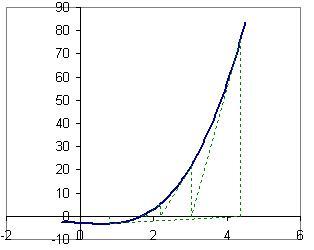
- Make a graph and cobweb to illustrate Newton's Method approaching
the root (recall we previously made a cobweb in the deer hunting model).
The cobweb should start at the first guess on the x-axis, go up to the graph, then
down to the next guess on the x-axis.
- Newton's method can fail or give varying answers. Try
the following functions and initial guesses:
- f(x) = arctan (x) , x0 = 1.395
- f(x) = cos (x) , x0 = 0.39, 0.40 and 0.41