This problem is merely a test of your ability to deal with endpoints.
Here is a graph of
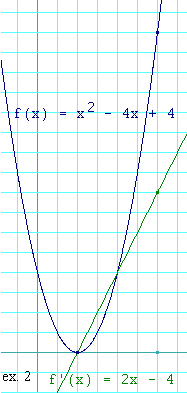 We can see that f'(x) has no discontinuities, so there
ought not be any cusps in this function.
We can see that f'(x) has no discontinuities, so there
ought not be any cusps in this function.
If we make a table of the values of f(x) and f'(x) at the endpoints, we get:
     f(2) = 0       f'(2) = 0

     f(6) = 16      f'(6) = 8
Here again is the decision tree for deciding whether endpoints are maximums or minimums:
                left end                    right end
                   |                           |
                   |     find f'(endpoint)     |
                  /|\                         /|\
                 / | \                       / | \
                /  |  \                     /  |  \
        positive zero negative       positive zero negative
      it's a min   |  it's a max   it's a max  |   it's a min
                   |                           |
                   |    if f'(endpoint) = 0,   |
                   |  take higher derivatives  |
                   |  at the endpoint until    |
                   |  you get one that's not   |
                   |  equal to zero            |
                  / \                         / \
                 /   \                       /   \
                /     \                     /     \
        positive       negative      positive      negative
      it's a min       it's a max        / \       / \
                                        /   \     /   \
                                       /     \   /     \
  derivative number even or odd?    even    odd even   odd
                               it's a min  it's a max  it's a min
Note that our left-hand endpoint yields zero for its derivative. According
to the decision tree, we take the next higher derivative until we get a
nonzero value. In this case,
The right-hand endpoint is no problem. We see that
email me at hahn@netsrq.com