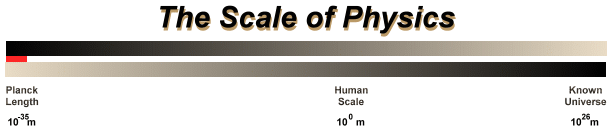
At the smallest and most basic level of our universe, we start by asking what exists and what things are made up from. We need a way to describe our world, so we talk about common concepts for us, space and time. But what are space and time? What is their nature and existence? Is it the everyday view that we grew up with or something a bit different?
In this segment, we will consider the basic nature of things from the conceptual viewpoint of some contemporary theories in physics. Our description may seem odd, but if it is a good theory, it must eventually lead us back to familiar ideas and results.
For this, the beginning level of our journey, we will consider what it means to have the smallest possible "thing." Consider a "thought experiment" that was first discussed by the ancient Greeks Leucippus and Democritus. For any material that you see, suppose you break it into two halves. Then, take one of these pieces and break it in half. Keep going, each time taking one of the halves and dividing it yet again. Eventually, you must stop when you reach the smallest possible object - an indivisible chunk called an atom. This atom of Democritus is not the atom we think of today, though. Unlike our atom, Democritus' atom absolutely cannot be taken apart into smaller pieces. When you think of going past this point, there is nothing in the universe left to look at! If we take this idea one step beyond the notion of material objects, as Democritus did, we see that his quest was a very fundamental one. He tried to reason the underlying nature of space and matter!
 |