§2.7: Why Did Strings Enter
The Story?
Quantum chromodynamics has worked very well in describing the observed behaviors and properties of elementary particles. But the theory itself only works well when gravity is so weak that it can be neglected, when Heisenberg uncertainty with respect to gravity can be ignored.
 |
 |
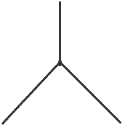
| Particle physics interactions (left) occur at zero distance, but string interactions (right) don't. That's what makes string theory more successful as quantum theory of gravity. |
|
Particles in string theory arise as excitations of the string, compatible with the requirements of the Heisenberg uncertainty principle. Unlike point particles which interact at a single point of space-time with zero distance between them, strings collide over a small, but finite, distance! The average size of a string would be somewhere near the Planck length, the length scale of quantum gravity, which is about 10-33 centimeters. Also, a good quantum theory of gravity must permit a theorized particle called the graviton, a particle with zero mass and two units of spin that would carry the gravitational force. Included in the excitations of a string in string theory is a particle with zero mass and two units of spin.
This led string theorists to propose that string theory be applied not as a theory of hadronic (nuclear) particles, but as a theory of quantum gravity.
It doesn't mean that string theory is free of problems, but the zero distance behavior lets us combine quantum mechanics and gravity, and talk sensibly about a string excitation that carries the gravitational force.

